
Fire Management and Wildfires in Costa Rica

Every year, during the months from January to May, news about wildfires across the country becomes common. These fires represent a threat to biodiversity, soils, human health, and water availability and quality. In addition, they contribute to the greenhouse effect and climate change due to the release of carbon dioxide and other gases.

Where are wildfires concentrated?
The region most affected by wildfires is the North Pacific, which includes the province of Guanacaste and the districts of Paquera, Lepanto, and Cóbano in Puntarenas. Likewise, the Central and South Pacific regions are other areas where the highest number of fires occur. Another region facing this issue is the Northern Huetar Region on the Atlantic slope, specifically in Los Chiles and Upala in the province of Alajuela. In recent years, the Central Valley has also experienced an increase in wildfires, mainly in urban and interface areas (urban-forest interface zones).1
These fires occur both on private lands and in Protected Wildlife Areas (Junquillal Wildlife Refuge, Santa Rosa, Guanacaste, Diriá, and Palo Verde National Parks, Los Santos Forest Reserve, Tivives and El Rodeo Protected Zones, Mata Redonda Wildlife Refuge, among others) as well as in secondary forests. In addition, some incidents have occurred in the Indigenous territories of Ujarrás, Salitre, and Cabagra.1
Why do they occur?
It is important to highlight that 98% of wildfires are caused by human activity.2 These may result from negligence or poor environmental practices such as throwing cigarette butts, leaving campfires unattended, or carrying out unauthorized burnings (such as burning waste). Furthermore, agricultural burning to prepare land is very common in Costa Rica, but these practices can also lead to uncontrolled fires.

The El Niño phenomenon is characterized by high temperatures and low rainfall, creating optimal conditions for fire to spread. Additionally, the La Niña phenomenon is also linked to El Niño and the effects of fire, since abundant rainfall allows biomass (grass, leaves, branches, and trees) to recover easily. The accumulation of this biomass favors the spread of fire during the following dry season.3
What is the current situation compared to previous years?
So far, the 2026 fire season has been the most critical in Costa Rica’s history, as by the end of April, 209 forest fires had already been recorded, surpassing 2024, which ended with 141 fires. These records only include the dry season, from January to April. Compared to the last five years, the figures are as follows:
2025: 43 fires
2024: 141 fires
2023: 32 fires
2022: 55 fires
2021: 17 fires4
During the 2026 season, fires have already consumed approximately 28,000 hectares, while in 2024 around 26,000 hectares were affected.5
What are the consequences of wildfires?
As mentioned earlier, wildfires have a direct impact on the environment, especially on biodiversity. Not only are trees and plants affected, but the habitats of many species are destroyed, putting their survival at risk. Animals experience stress, anxiety, and disorientation; they become dehydrated due to smoke inhalation, may suffer asphyxiation, and are often unable to escape the flames. They may also suffer burns that can cause permanent injuries or death.
Similarly, fires destroy habitats that serve as resting and connectivity areas for species, including migratory birds that travel through the country.² It is also important to remember that trees act as carbon sinks by absorbing carbon dioxide (CO₂). When forests burn, CO₂ and other greenhouse gases are released into the atmosphere, contributing to global temperature rise and worsening climate change.
In addition to environmental impacts, the socioeconomic implications are significant. Extinguishing a forest fire requires costly resources, including equipment, personnel, and logistics. Furthermore, damage to infrastructure such as power grids and water sources may also occur.
What actions have been taken at the national level?
Since 1997, the National Commission on Wildfires (CONIFOR) was created under the Ministry of Environment and Energy (MINAE) through the National System of Conservation Areas (SINAC). CONIFOR is responsible for the formulation, management, support, monitoring, and evaluation of the National Fire Management Strategy.1 This strategy is updated every nine years, and its objective is to protect human life, preserve biodiversity, reduce the impact of fires, and coordinate institutions and communities.
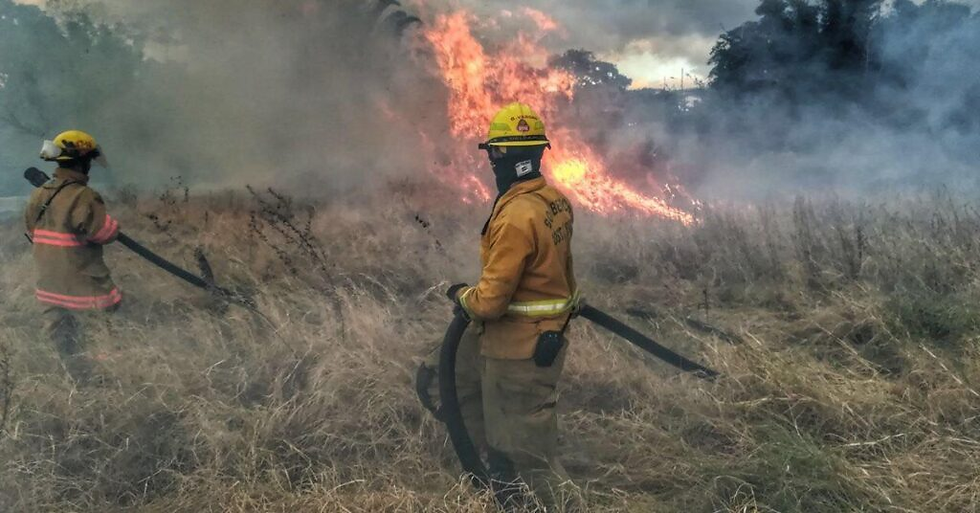
On the other hand, firefighters play a fundamental role, since without their work, it would not be possible to extinguish fires and prevent more hectares from being consumed. There is a specialized forest fire brigade composed of SINAC personnel trained by the General Forestry Directorate (DGF),6 together with members of the Fire Department and volunteers from different regions.
How can wildfires be prevented?
Do not throw cigarette butts or flammable objects into vegetation areas
Only build campfires in authorized areas and make sure they are completely extinguished
Avoid agricultural burning and burning waste in vacant lots
Keep firebreaks and property boundaries clean
Prevent children from playing with matches or lighters, both inside and outside the home
Do not leave glass bottles or cans in nature, since direct sunlight on these objects may cause fires
Join volunteer brigades in your community
What should you do if you witness a wildfire?
Stay calm and move away from the area
Do not attempt to fight the fire on your own
Notify the authorities. If the fire occurs in an urban area, call 911. If it occurs within or near a protected area, contact the nearest SINAC office
If you find affected wildlife, guide the animal to a safe area (avoiding direct handling) or keep it within sight. Contact the police or the nearest SINAC office. You may also call 911 or the SITADA hotline at 1192
These small actions only take a few minutes of our time and can help prevent major tragedies in our forests. Let us be responsible for our own actions. Let us help spread this information and raise awareness about the socio-environmental issues taking place in our country. Your contribution may be more valuable than you imagine!
References
Comisión Nacional sobre Incendios Forestales (CONIFOR). Estrategia Nacional de Manejo Integral del Fuego en Costa Rica 2012-2021. 2014. https://www.sinac.go.cr/ES/partciudygober/Documents/Estrategia%20Nacional%20Manejo%20del%20Fuego.pdf
Mora, Guiselle. “Incendios forestales, prevención en conjunto.” Radios UCR. 7 marzo 2025. https://radios.ucr.ac.cr/-/incendios-forestales-prevencion-en-conjunto
Picado, Wilson. “Incendiarismo y Pirocultura en el Bosque Tropical Seco de Costa Rica. La Historia del Fuego como Historia Aplicada.” Historia Ambiental Latinoamericana y Caribeña (HALAC) Revista de la Solcha, 11(2), 173-213. https://doi.org/10.32991/2237-2717.2021v11i2.p173-213
Mena, Maria. “Récord de 209 incendios forestales en Costa Rica: Bomberos alertan un escenario más complejo por El Niño.” El Observador. 25 abril 2026. https://observador.cr/record-de-209-incendios-forestales-en-costa-rica-bomberos-alertan-un-escenario-mas-complejo-por-el-nino/
Ballestero, Rebeca. “Más de 22 mil hectáreas de bosque han sido afectadas por incendios forestales en 2024.” CR Hoy. 1 mayo 2024. https://crhoy.com/nacionales/hectareas-afectadas-en-incendios-forestales-han-aumentado-un-2243-en-los-ultimos-11-anos/
Sistema Nacional de Áreas de Conservación (SINAC). Brigadas de incendio. ttps://www.sinac.go.cr/ES/partciudygober/ales/Paginas/brigincen.aspx
Comments